
If your operation depends on accurately measuring the volume of fluid moving through a process, a growing industry trend may be introducing more risk than many organizations realize.
Flow meter calibration has long been the foundation of manufacturing processes that rely on precise fluid delivery. Yet today, some manufacturers are reducing—or eliminating—formal calibration programs in favor of internal “self-verification” methods. While verification has its place, confusing it with true calibration can expose products, processes, and businesses to significant risk.
The Role of Flow Meter Calibration
Flow meter calibration ensures that measurements of liquid flow remain accurate, repeatable, and traceable to a recognized national standard. These measurements often directly influence product quality, formulation consistency, regulatory compliance, and cost control.
When calibration is removed from the equation, manufacturers lose an essential safeguard—one that confirms not only that the meter is functioning, but that it is measuring correctly.
How Internal Verification Works
Some modern flow meters include built-in self-verification features designed to reduce the frequency of formal calibration. These systems store baseline data for critical internal measurement circuits and continuously monitor those values for change.
During verification, the meter checks its own timing, voltage, and current against internal reference values and produces a pass/fail result. These internal standards are originally calibrated at the manufacturer’s facility using ISO/IEC 17025–accredited, NIST-traceable equipment.
Product marketing often suggests that this self-verification capability eliminates the need for future, more invasive calibration procedures. In the short term, this can appear to be a reasonable approach.
The problem? Standards age.
Why Verification Is Not Calibration
ISO/IEC 17025 clearly distinguishes between verification and calibration. Section 3.8, Note 5 defines verification as:
“The provision of objective evidence that a given item fulfills specified requirements.”
Verification confirms that a device meets a predefined condition—but it does not establish measurement accuracy against an external reference.
Calibration, by contrast, requires comparison against a NIST-traceable reference standard that itself has a valid calibration certificate. For flow meters, this means verifying performance against a known, independent standard across the operating range of the application.
Without this comparison, a flow meter—regardless of how sophisticated its internal checks may be—is not calibrated.
The Risk of Relying on Verification Alone
Internal verification can provide value by detecting short-term electronic drift and narrowing the uncertainty window between calibrations. Used correctly, it can support a robust quality program.
However, replacing calibration entirely with verification introduces substantial risk. Internal standards are still subject to drift over time, which is why ISO 9001 and other quality systems require periodic revalidation against external standards.
Without regular recalibration to NIST, confidence in a meter’s long-term accuracy erodes—and errors can go undetected for extended periods. When flow measurements influence product quality, safety, or compliance, those errors can have serious downstream consequences.
Why You Must Calibrate Flow Meters
Calibration procedures exist in every major quality standard for a reason: they protect against undetected measurement drift and ensure that instruments remain fit for purpose.
For flow meters, calibration:
- Confirms accuracy against a known reference
- Identifies and corrects long-term drift
- Re-centers measurement performance within specified tolerances
- Prevents costly product deviations and process failures
Regular calibration acts as a “health check” for your measurement system—one that verification alone cannot replace.
Flow Meter Calibration at Precision Calibration Systems
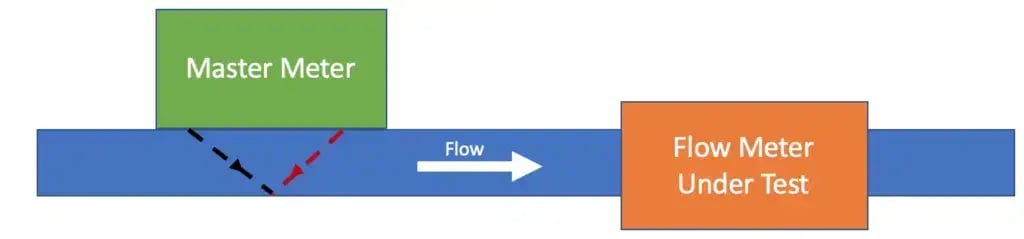
At Precision Calibration Systems (PCS), we perform flow meter calibration using the proven Master Meter technique. In this method, a highly accurate master flow meter is installed in series with the meter under test. Multiple flow rates are measured simultaneously, and calibration adjustments are made until the test meter’s readings align with the master.
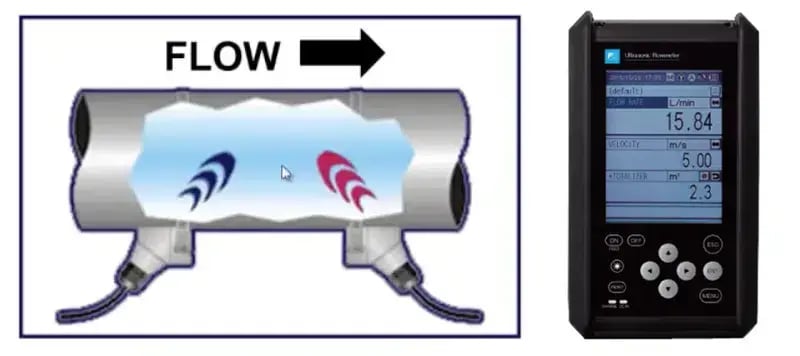
Our master meters are fully traceable to NIST standards and utilize differential ultrasonic measurement technology to achieve exceptional accuracy across a wide flow range.
Accuracy Without Compromise—or Downtime
Verification can be a useful tool. Calibration is a necessity. When both are used correctly, they form a comprehensive approach to measurement assurance.
When your production flow meter—or any other critical instrument—needs calibration, PCS delivers accurate, NIST-traceable results with fast turnaround times designed to minimize downtime. Contact PCS for a quote and see how quickly reliable calibration can be completed.