
Flow Meter Calibration Services
Flow Meter Calibration from Precision Calibration Systems
When your flow meters drift out of calibration, the consequences ripple through every part of your operation: wasted resources, costly process interruptions, quality failures, and compliance headaches. That’s why business owners and facility managers trust Precision Calibration Systems for ISO 17025-accredited flow meter calibration—delivered on your schedule and backed by a national network of expertise.
As a proud member of the Accredited Labs network, PCS delivers precise, compliant calibration for ultra-pure water, wastewater, potable water, and more, supporting industries from pharma and semiconductors to municipal water treatment.
Flow Calibration Capabilities:
- (0 – 400 Gallons/min)
- Liquid applications including ultra-pure water, alcohol, wastewater and many others
- Pipe Diameter: 0.5” (13mm) to 240” (6000mm)
- Process temperature capability -40 °C to 200 °C
- Consumed Energy Calculation upon request
- Uncertainty 0.4% to 0.6% depending on total flow rate
On-Site or In-Lab: Flexible Calibration Services
- On-site flow meter calibration available in select areas
- Master Meter technique works with most standard pipe materials.
- ISO-17025 accredited NIST flow meter calibration, not just verification.
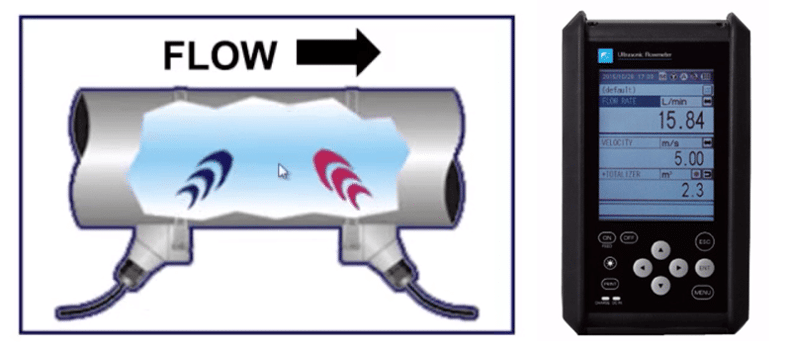
Left: Differential Ultrasonic Transceiver in Use. Right: Fuji PortaFlow C F SC 2
A transit time flow meter uses two ultrasonic transceivers, a fixed distance apart, to inject sound waves into the fluid. Sound waves hitch a ride on the medium they are transmitted in, so the sound travelling in the direction of fluid flow will be faster than the speed of sound in the same fluid with no flow. Similarly, the sound transmitted against the flow will travel at a slower speed compared to its speed in the static fluid.
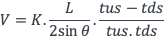
The master meter measures the time of flight of ultrasonic pulses travelling with the flow and those travelling against it. Simple math shows fluid velocity is proportional to the time taken for the sound to travel between the sensors.
![]()
Where:
V = Fluid velocity
K = Calibration constant
tus = upstream transit time
tds = downstream transit time
L = Time of Flight distance between sensors
θ = Incident angle of ultrasonic waves
Note the calibration constant K takes various linear properties into account, including variation in the pipe’s internal structure, such as roughening or corrosion that can affect turbidity of the fluid.
What Is Flow Calibration, and Why Does It Matter?
Flow calibration systematically verifies and adjusts your instruments so you always get accurate, traceable measurements that are essential for regulatory compliance, product quality, and operational efficiency. Our experienced technicians test your equipment across its full flow range, document any deviations, and make precise adjustments. If your instrument can’t be adjusted to spec, you’ll receive detailed calibration reports to guide your next steps.
What Makes Us Different
Powered By Accredited Labs
As part of the Accredited Labs network we bring you industry-leading calibration services backed by ISO/IEC 17025 accreditation, advanced technology, and a commitment to precision.
Customer-Centered Service
We prioritize clear communication, consistency, and reliability. Your equipment is calibrated accurately, on time, and with minimal disruption to your operations.
Tailored Solutions for Your Industry
Our expert team takes the time to understand your unique calibration needs, providing customized support to keep you compliant and performing at your best.
Frequently Asked Questions
-
How can calibration historical data be used to prevent measurement errors and operational issues?
Historical calibration data is an invaluable resource for proactive maintenance and process optimization. By regularly reviewing trends in calibration results, our technicians can spot gradual changes or drifts in your flow meters’ performance before issues escalate. This allows us to address instrument wear, compensate for output shifts, and prevent discrepancies that may otherwise lead to over-dosing, off-spec batches, wasted materials, or unscheduled downtime.
Using this data-driven approach, we help you catch small deviations early—reducing the risk of shipping delays and ensuring each process run meets your production and quality targets. This continuity in monitoring not only minimizes costly interruptions but also supports efficient operations and improved yields over time. -
How does fluid type affect flow calibration requirements?
Fluid properties such as viscosity, density, temperature, and compressibility all influence how a flow meter behaves. Calibration should ideally be performed using the actual process fluid or a fluid with similar properties, or corrections must be applied. Gas and liquid flow calibrations often follow different standards and use different reference systems, so it is important to communicate your process conditions to your calibration provider.
-
What standards are typically used for flow calibration?
Flow calibration standards vary by fluid type and industry. Common references include standards from organizations such as NIST, ISO, and ASME, as well as industry-specific guidelines from sectors like oil and gas, pharmaceutical, and food processing. The applicable standard is typically determined by the regulatory or quality requirements governing your process.
-
How can out-of-tolerance flow meters affect my process or product quality?
Inaccurate flow measurement can have significant downstream consequences — including incorrect dosing in pharmaceutical production, improper chemical mixing in industrial processes, billing disputes in custody transfer applications, and regulatory non-compliance in environmental monitoring. Regular calibration helps detect and correct drift before it leads to process errors or costly product quality issues.
ISO/IEC 17025 Accredited
Calibration from PCS
-
ISO/IEC 17025 accredited calibration services
-
Affordable calibration services with some of the fastest turnaround times in the industry
-
Mail-in laboratory calibration available in all 50 states
-
On-site calibration service available in Tennessee, Virginia, Alabama and Kentucky