
Spectrophotometer Calibration: Requirements, Methods & What to Expect
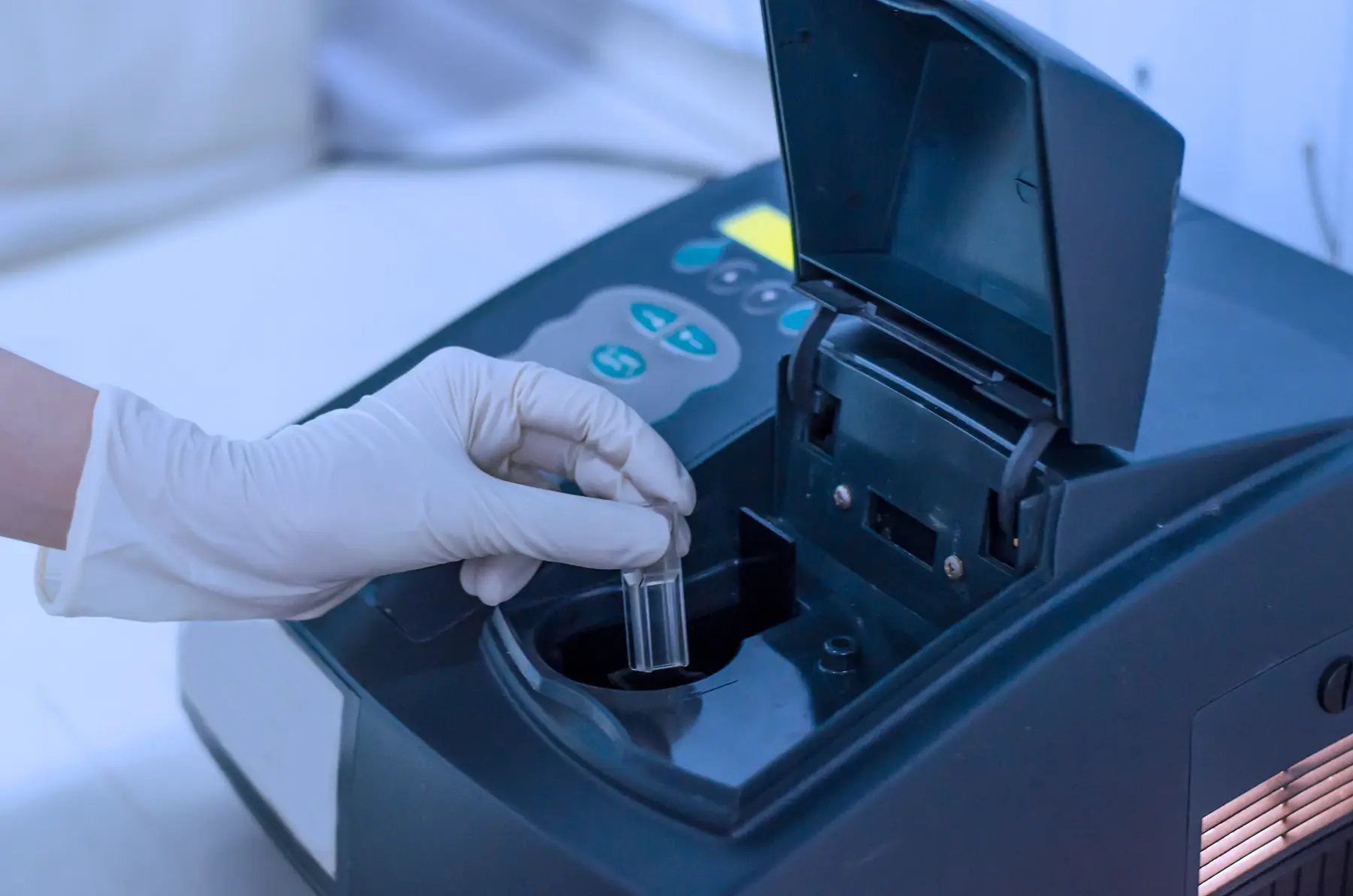
Spectrophotometers are precision optical instruments used to measure how much light a sample absorbs or transmits at specific wavelengths. In laboratory, pharmaceutical, medical, food and beverage, and manufacturing environments, the accuracy of a spectrophotometer directly affects the validity of every analysis it supports — from concentration measurements and purity assessments to color matching and material characterization.
Like all measurement instruments used in quality-critical applications, spectrophotometers require periodic calibration to verify their performance and maintain the measurement integrity your quality system and regulatory requirements depend on.
What spectrophotometer calibration involves
Spectrophotometer calibration is a documented process of verifying an instrument's performance across its operating range — checking that it measures light absorption and transmission accurately at the wavelengths relevant to your application. A professional calibration service evaluates several key performance parameters:
Wavelength accuracy verifies that the instrument is correctly identifying the wavelengths it measures. A wavelength error — even a small one — can shift absorbance readings and affect the validity of quantitative analysis.
Photometric accuracy verifies that the instrument's absorbance or transmittance readings are correct across its measurement range. This is typically checked at multiple points using certified reference standards with known absorbance values.
Stray light assessment evaluates whether unwanted light is reaching the detector, which can cause errors particularly at high absorbance values.
Noise and drift checks verify instrument stability over time, which affects the reproducibility of measurements.
All results are recorded as-found — before any adjustments — and as-left after calibration, giving your quality system a complete picture of instrument performance at both points. This as-found/as-left documentation is critical for assessing whether any measurements taken since the last calibration may have been affected by instrument drift.
Methods and reference standards
Spectrophotometer calibration relies on certified reference materials and standards with known optical properties. Wavelength calibration typically uses holmium oxide or didymium filters, whose sharp absorption peaks at specific wavelengths provide reliable reference points. Photometric accuracy is verified using certified neutral density filters or standard reference solutions with traceable absorbance values.
Calibration procedures should follow validated methods appropriate to the specific instrument type. UV-Vis spectrophotometers, NIR instruments, and fluorescence spectrophotometers each have distinct calibration requirements and applicable standards. The selected calibration laboratory should have suitable reference materials, validated procedures, and demonstrated technical competence for each instrument type referenced on their scope of accreditation
The role of ISO/IEC 17025 accreditation in spectrophotometer calibration
ISO/IEC 17025:2017 is the international standard for the competence of testing and calibration laboratories. Most quality standards your organization may be registered to — including ISO 9001, AS9100, and ISO 13485 — require that measurement equipment be calibrated and traceable to national or international standards. ISO/IEC 17025 accreditation is the most reliable way to demonstrate that traceability and supplier competence.
For organizations operating under standards like IATF 16949 or ISO 15189 — common in medical laboratory and automotive manufacturing environments where spectrophotometric measurement is used — accreditation carries additional weight. ISO 15189 specifically recognizes ISO/IEC 17025 accredited laboratories as meeting competence requirements; non-accredited labs must prove equivalent competence independently.
Metrological traceability, often informally referred to in the United States as 'NIST traceability,' is the documented, unbroken chain of calibrations linking measurement results to the International System of Units (SI), typically through national metrology institutes such as NIST. ISO/IEC 17025:2017 requires laboratories to establish and document this traceability where technically possible.
What your calibration certificate should contain
A compliant spectrophotometer calibration certificate provides the documented evidence your quality system needs. Before filing any certificate, verify it includes:
- Instrument identification — make, model, serial number, and any relevant accessories
- The calibration date and certificate issue date
- The calibration procedure and reference standards used, with traceability information
- As-found measurements — instrument performance before any adjustment
- As-left measurements — instrument performance after calibration
- Environmental conditions during calibration that affect the measurement result, including temperature, where applicable
- A statement of measurement uncertainty
- The accreditation body and certificate number of the calibrating laboratory
If a certificate you receive does not include as-found data, contact the calibration provider before filing it. Without as-found measurements, you cannot assess whether readings taken since the last calibration were within acceptable limits.
Setting calibration intervals for spectrophotometers
How often a spectrophotometer needs calibration depends on the manufacturer's recommendation, the frequency and intensity of use, the stability of the operating environment, and the risk level of the measurements it supports. Instruments used in regulated laboratory environments — pharmaceutical QC, clinical analysis, food safety testing — typically warrant shorter intervals than instruments used for general reference purposes.
As with any measurement instrument, reviewing as-found data at each calibration is the most defensible basis for interval decisions. An instrument consistently found well within tolerance supports extending the interval. One regularly found near or outside tolerance warrants a shorter one. The data makes the decision, not a default annual schedule.
Industries and applications
Spectrophotometer calibration is relevant across a broad range of industries and applications. In pharmaceutical and biotech environments, spectrophotometers support concentration analysis, purity testing, and raw material verification. In food and beverage production, they are used for color analysis and quality control. In medical and clinical laboratories, spectrophotometric methods underpin a wide range of diagnostic assays. In manufacturing, they support material characterization and process control.
In each of these environments, an out-of-tolerance spectrophotometer is not just a quality system finding — it is a potential source of invalid results, compliance risk, and product liability.
Precision Calibration Systems provides ISO/IEC 17025:2017 accredited spectrophotometer calibration from its Morristown and Winchester, Tennessee laboratories, with on-site service available across Alabama, Kentucky, Tennessee, and Virginia.
Ready to schedule spectrophotometer calibration for your facility? Precision Calibration Systems offers ISO/IEC 17025:2017 accredited service with on-site options across Tennessee and the surrounding region.
FREE DOWNLOAD
The Complete Guide to ISO/IEC 17025 Conformity Readiness
Download the Complete Guide to ISO/IEC 17025 Conformity Readiness — a practical reference for quality managers covering what ISO 9001, AS9100, IATF 16949, and more actually require, what a compliant certificate should contain, and how to set and justify calibration intervals.
Request a Quote for Precision Calibration from PCS
-
ISO/IEC 17025 accredited calibration laboratory
-
Affordable calibration services with some of the fastest turnaround times in the industry
-
Mail-in laboratory calibration available in all 50 states
-
On-site calibration service available in Tennessee, Virginia, Alabama and Kentucky