
How to Calibrate a Universal Testing Machine with Minimal Downtime
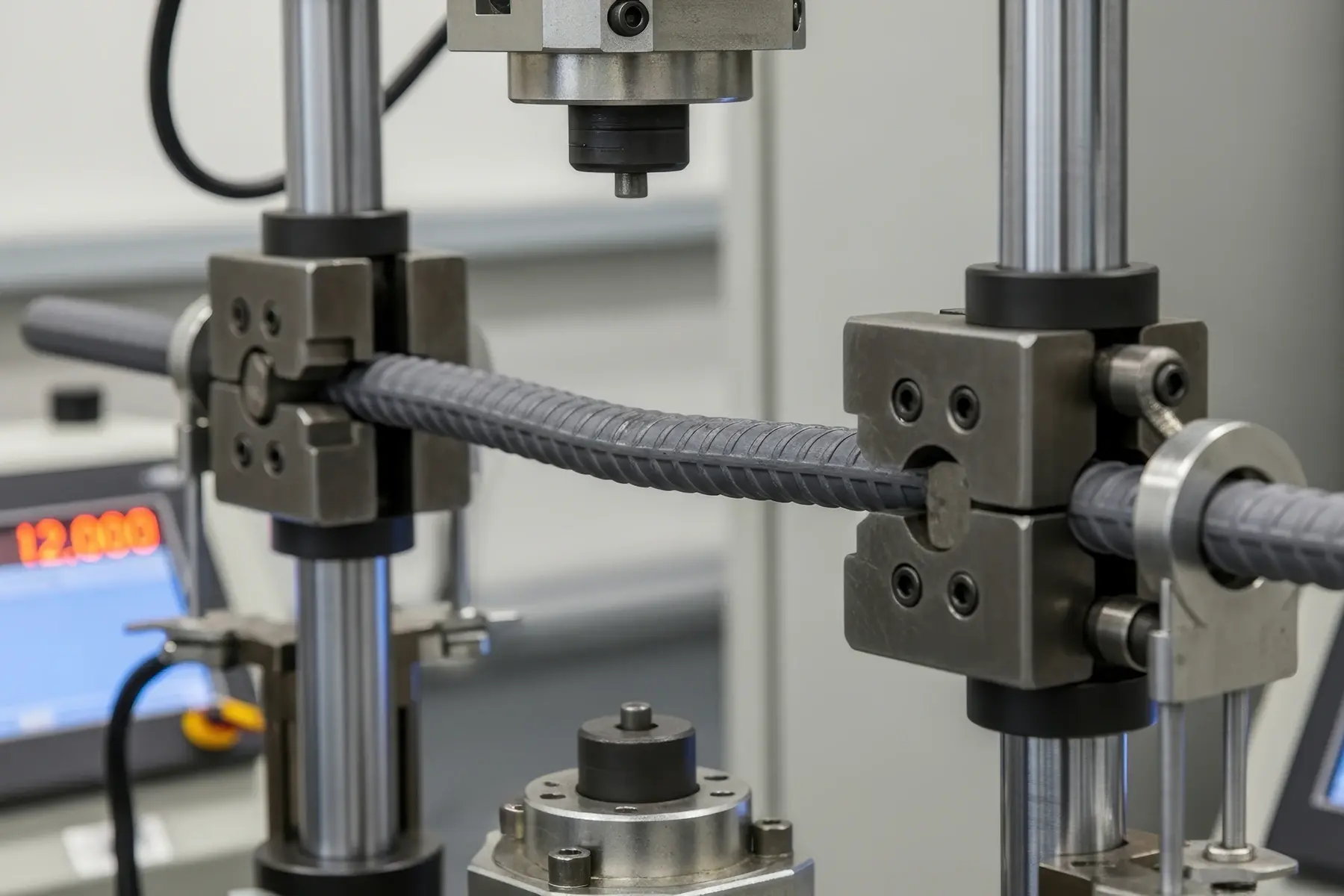
Calibrating a Universal Testing Machine (UTM) involves far more than scheduling a service call. Multiple technical factors must be evaluated before calibration even begins—and overlooking any of them can lead to delays, rework, or unnecessary production downtime.
Key considerations include:
- The capacity and quantity of load cells installed
- Whether calibration is required in tension, compression, or both
- Verification of crosshead speed and displacement
- The presence of extensometers requiring independent calibration
Understanding the Universal Testing Machine
Universal Testing Machines are foundational tools across a wide range of industries. Commonly referred to as tensile testers or compression machines, UTMs are used to evaluate material behavior under controlled loading conditions.
While they are traditionally associated with tensile strength, elongation, bending, and compression testing, UTMs support far more diverse applications, including:
- Adhesion testing for packaging materials
- Delamination force testing in semiconductor manufacturing
- Bond strength verification across layered materials
- Specialized force and displacement analysis in R&D environments
- Their versatility makes UTMs indispensable—and calibration critical.
Why Calibrate a Universal Testing Machine?
Most quality management systems require periodic calibration of instruments that measure critical product parameters. Calibration ensures that measurements continue to meet manufacturer specifications and remain traceable to a recognized national standard, such as the National Institute of Standards and Technology (NIST).
Material properties are typically validated during the design phase, but they can evolve as processes are refined or scaled. A properly calibrated UTM ensures that material performance in production remains within the tolerance limits established during design—and that all measurements are traceable, defensible, and repeatable.
How Is a Universal Testing Machine Calibrated?
To ensure consistency and repeatability across laboratories and technicians, calibration procedures are governed by established industry standards. ASTM International (formerly the American Society for Testing and Materials) is one of the primary organizations responsible for developing these standards, which are widely adopted across manufacturing and testing environments.
PCS develops and performs all UTM calibrations in accordance with applicable ASTM standards, including:
- ASTM E4 – Calibration of force measurement systems in tension and compression. This standard defines correct load application, alignment, and verification methodology. Two independent runs are required to confirm results fall within allowable tolerances.
- ASTM E2658 & ASTM E2309 – Verification of crosshead speed and displacement accuracy.
- ASTM E2624 – Torque calibration.
- ASTM E467 – Dynamic force (impulse) testing.
Together, these standards ensure that every aspect of UTM performance is evaluated against a known, traceable reference.
Extensometers and UTMs
Measuring the minute dimensional changes caused by tensile or compressive forces presents one of the greatest challenges in materials testing. Establishing reliable statistical norms for extension and contraction requires both high-precision instrumentation and repeatable calibration processes.
Extensometers are designed specifically to measure these small physical responses with extreme accuracy. At PCS, we utilize Epsilon extensometer calibrators, capable of resolving 80 nm (0.8 microinches) over a 50 mm (2-inch) range. These systems meet or exceed the requirements of ISO 9513 and ASTM E83 Class B-1, delivering exceptional accuracy and repeatability across the operating range of most UTMs.
Expedited Calibration Without Compromising Accuracy
While many calibration laboratories possess the technical expertise to calibrate a Universal Testing Machine, technical competence alone doesn’t solve the real-world problem faced by engineers and production managers: lost time.
There is never an ideal moment to take critical equipment offline. That’s why minimizing calibration-related downtime should be a priority—not an afterthought. PCS is focused on delivering some of the fastest average turnaround times in the industry, supported by data and driven by process efficiency.
When your Universal Testing Machine—or any other critical instrument—needs calibration, choose a partner that values both precision and productivity. Contact PCS for a quote and experience just how quickly accurate calibration can be delivered.
ISO/IEC 17025 Accredited Calibration From PCS
-
ISO/IEC 17025 accredited calibration services
-
Affordable calibration services with some of the fastest turnaround times in the industry
-
Mail-in laboratory calibration available in all 50 states
-
On-site calibration service available in Tennessee, Virginia, Alabama and Kentucky